


When Lighting Really Matters: Getting Emergency Lighting Right

Updated: 5 days ago
Emergency lighting is one of those things that often goes unnoticed until it's needed most. In the event of a power failure or emergency, it plays a critical role in helping occupants navigate a building safely, illuminating escape routes and reducing the risk of panic.
However, simply installing emergency fittings doesn't necessarily mean a building has adequate emergency lighting.
Getting it right involves more than choosing the right fittings. It requires careful consideration of the building, its occupants, the relevant standards and how the system will be maintained throughout its lifetime.
Together with the team at Lumineux, we're exploring some of the most common mistakes, important regulatory updates and practical considerations that contractors should be aware of when approaching their next emergency lighting installation.
Getting the specification right
When it comes to emergency lighting, there's no one-size-fits-all approach. A warehouse, school, office or healthcare facility can have very different requirements, depending on how the building is used, its layout and the people occupying it.

As Lumineux explains, understanding the environment and how occupants would safely evacuate is essential before specifying a system. Some of the key considerations include:
Escape routes and exits: Ensuring routes are adequately illuminated, including changes in direction, stairways and final exits.
Mounting heights and positioning: Considering how the height and location of luminaires affect light distribution and coverage.
Required illumination levels: Different areas have different lighting requirements, particularly escape routes, open areas and high-risk task areas.
Emergency duration: Determining how long emergency lighting must remain operational following a power failure.
Open areas: Larger spaces, particularly those exceeding 60m², may require specific consideration for anti-panic lighting.
Building occupancy: Understanding who uses the building, when it's occupied and whether occupants may require additional assistance during evacuation.
One of the most common misconceptions Lumineux encounters is the assumption that simply having emergency fittings installed means a building is adequately covered.
The number of fittings alone doesn't determine whether an installation is compliant. It's their positioning, performance and ability to provide the required illumination that matter.
For example, a warehouse with high racking presents different challenges from an open-plan office. Obstructions, mounting heights and the arrangement of escape routes can all influence the effectiveness of the emergency lighting.
This is where a professional lighting design and advice can make a significant difference, helping contractors identify potential gaps in coverage before installation begins. Manufactureres like Lumineux offer free survey on emergency lighting, ensuring the safety of a building fits the needs and meets the latest regulations.
Common mistakes that could compromise an installation
Even with suitable products, emergency lighting installations can fall short when important considerations are overlooked during design and specification.
According to Lumineux, one of the biggest mistakes is treating emergency lighting as an afterthought rather than an integral part of the building's safety provision. Some common issues to be aware of include:
Insufficient coverage: Installing emergency fittings at regular intervals doesn't necessarily provide adequate illumination. Attention should be given to changes in direction, stairways, intersections and areas where occupants need to identify safety equipment.
Choosing products based on price alone: While cost is naturally a consideration, emergency luminaires are safety-critical products. Contractors should ensure products meet the relevant requirements of BS EN 60598-2-22, carry applicable conformity markings and are supported by appropriate testing and documentation.
Quality components, reliable battery performance and manufacturer support are particularly important when considering the long-term reliability of an installation.
Failing to consider ongoing maintenance: Emergency lighting must be regularly tested and maintained. Installing fittings in difficult-to-access locations or failing to consider how testing will be carried out, can create unnecessary challenges for building operators.
Lumineux emphasises that professional lighting design, site surveys and manufacturer technical support can help contractors avoid these issues, particularly on larger or more complex projects.
Emergency lighting standards: What contractors need to know
Emergency lighting is governed by several regulations and standards and understanding how they apply in practice is important for a compliant install.
The Regulatory Reform (Fire Safety) Order 2005: This places legal duties on the Responsible Person, typically the employer, owner or person in control of the premises, to ensure appropriate fire safety measures are in place, including emergency lighting where required.
Contractors and designers play an important role in helping the Responsible Person meet these obligations by ensuring emergency lighting systems are correctly designed, specified and installed.
Emergency routes and exits requiring illumination must be provided with emergency lighting of adequate intensity in the event of failure of their normal lighting.
BS EN 1838 – Emergency Lighting: This establishes lighting performance requirements, including illumination levels and uniformity for escape routes, open areas and high-risk task areas.
BS EN 60598-2-22 – Emergency Luminaires: This covers safety requirements and testing for emergency lighting products, helping ensure luminaires are suitable for their intended purpose.
BS 5266-1:2025 – Emergency Lighting Code of Practice: The revised British Standard provides updated guidance on the design, installation and management of emergency lighting systems.
For contractors, the 2025 revision is an important opportunity to review existing approaches to specification and installation. Two important considerations highlighted by Lumineux:
1. Consider what happens if a fitting fails
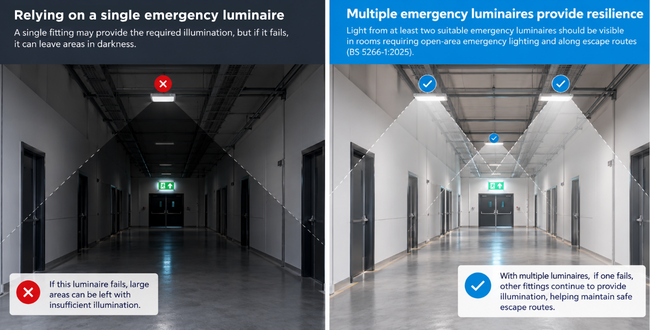
Lumineux highlights updated guidance recommending that light from at least two suitable emergency luminaires should be visible in rooms requiring open-area emergency lighting and along escape routes.
Why does this matter?
A single emergency fitting might provide the required illumination under normal operating conditions, but what happens if that fitting fails? Considering the number and positioning of luminaires helps reduce reliance on individual fittings and improves the resilience of the installation.
For contractors, this reinforces the importance of looking beyond minimum illumination levels and considering potential points of failure during the design stage.
2. Don't rely on borrowed light
Another important clarification concerns borrowed light, such as daylight or illumination from adjoining areas. The revised guidance makes clear that borrowed light shouldn't be relied upon to meet emergency lighting requirements.
For contractors working on refurbishment projects or reviewing existing installations, it's worth considering whether previous designs relied on assumptions about available light that may no longer be appropriate.
Installation is only the beginning: Testing and maintenance
Once an emergency lighting system is installed, the responsibility doesn't end there. Regular testing and maintenance are essential to ensure the system will operate correctly when required.
Emergency lighting generally requires a brief monthly functional test and an annual full-rated-duration test, with results documented and any faults addressed.
However, the method of testing can have a significant impact on the time and resources required to maintain a system.
Manual testing - Traditional testing involves physically checking emergency luminaires and recording the results. While this may be manageable in smaller buildings, it can become particularly time-consuming across larger commercial premises with hundreds of fittings. It also relies on tests being carried out consistently and accurate records being maintained.
Self-test emergency lighting - Self-test fittings automatically perform scheduled functional and duration tests, displaying the results through indicators on the fittings. This reduces the need to initiate tests manually and can make identifying faults more straightforward. However, the results still need to be checked and recorded, and any faults must be addressed.
For contractors, recommending self-test fittings can be a practical way to simplify ongoing maintenance for customers.
Lumineux's E-Sel3 range offers installers the flexibility to choose between manual-test and self-test emergency lighting, helping them select a solution that suits the building's requirements and ongoing maintenance needs.
Connected emergency lighting systems - For larger buildings or multi-site environments, connected monitoring systems offer a more advanced approach. These systems allow emergency fittings to be monitored and managed centrally, helping building operators schedule tests, identify faults and maintain testing records.
Lumineux's LumiWave wireless emergency lighting system provides a connected solution for managing emergency lighting testing and reporting.

For facilities such as schools, universities, healthcare environments and commercial buildings, this approach can help reduce the administrative burden associated with maintaining large numbers of emergency luminaires.
Why should contractors consider this during specification?
Because the initial installation cost is only one part of the equation. A system that's easier to test, monitor and maintain can offer significant long-term benefits, particularly where access is difficult or large numbers of fittings are involved.
Discussing these options with customers early in a project can help identify the most appropriate solution for both their immediate requirements and ongoing maintenance responsibilities.
Lumineux's advice for contractors
With so many factors to consider, we asked Lumineux what advice they'd give contractors approaching an emergency lighting project.
Understand the building before specifying
Every building has different requirements. What worked on a previous project won't necessarily be suitable for the next. Take the time to understand the environment, occupancy and evacuation arrangements before selecting fittings.
Think beyond the initial installation
Testing, maintenance and accessibility should all be considered during the design stage. Ask how the customer intends to manage ongoing testing and whether self-test or connected systems could offer a more practical long-term solution.
Make use of manufacturer expertise
Contractors don't need to approach complex emergency lighting projects alone. Lumineux provides professional lighting design and technical support, helping contractors with product selection, specification and installation queries.
Whether it's a straightforward refurbishment or a larger commercial project, involving technical specialists early can help identify potential challenges and ensure the proposed solution meets the building's requirements.
Need support with your next emergency lighting project?
At 7 Core Electrical, we work closely with trusted suppliers like Lumineux to help contractors access the right products, professional lighting design and technical expertise.
Whether you're planning a new installation or upgrading an existing system, we're here to help.
Speak to your local 7 Core Electrical branch to discuss your next project. Get in touch by filling in this enquiry form here.


Comments